En esta entrada explicamos el uso de instrucciones de lógica Boolena en Facilino.
¿Qué es la lógica booleana?
La lógica booleana es el conjunto de relaciones que existen entre variables que pueden ser binarias, esto es, que pueden tomar sólo dos posibles valores: verdadero o falso. Las variables binarias o booleanas son muy importantes en el entorno de la electrónica digital, dado que son la base para entender cómo funcionan los circuitos electrónicos digitales y por extensión los microcontroladores, microprocesadores y la programación en general.
Tipo de instrucciones en Facilino
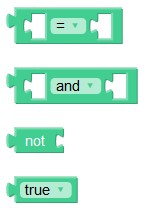
Operadores relacionales
Los operadores relacionales permiten establecer la comparación numérica entre dos variables (de todos los tipos básicos de Arduino a excepción de las cadenas de texto).
Permiten establecer relaciones de: igualdad; desigualdad; menor; menor o igual que; mayor; y mayor o igual que.
El resultado de la comparación es una operación lógica que devuelve verdadero o falso en función de los valores comparados y la operación seleccionada.
Operadores binarios
Facilino permite trabajar con operaciones booleanas a partir de dos argumentos(u operandos) de entrada binarios A y B, con valores verdadero (T) o falso (F). Según el operador booleando seleccionado el resultado de la operación cambiará:
| Operando A | Operando B | Operación «Y» | Operación «O» | Operación «O Excl.» | Operacíon «O No-Excl.» | Implicación |
|---|---|---|---|---|---|---|
| F | F | F | F | F | T | T |
| F | T | F | T | T | F | T |
| T | F | F | T | T | F | F |
| T | T | T | T | F | T | T |
Negación
La negación permite obtener la negación de una variable binaria, esto es, si el valor de la variable es cierto, la negación devolverá falso y viceversa.
Constantes Verdadero/Falso
Las constantes «Verdadero» o «Falso» permite ser utilizadas de igual manera que cualquier otra variable del tipo binario. La principal diferencia es que siempre valen «Verdadero» o «Falso» y su valor no se puede cambiar.
Ejemplos
Ejemplo 1
En este ejemplo se implementa una sencilla operación lógica booleana con una AND de dos entradas digitales que activan una salida digital. Concretamente, las entradas digitales corresponden a dos botones conectados a los pines D2 y D3 de Arduino Nano, mientras que la salida digital es en realidad el propio LED integrado de Arduino Nano.
Ejemplo 2
En este segundo ejemplo se muestra cómo utilizar los operadores relacionales. Concretamente, se compara un número secreto con otro número que introduce el usuario a través de la consola. Si los dos números son iguales, muestra un mensaje de felicitación, mientras que si son diferentes muestra un mensaje invitándole al usuario a que lo intente de nuevo.